HPLC Principle
High-Performance Liquid Chromatography (HPLC) is one of the most widely used analytical techniques in food testing, pharmaceutical analysis, environmental monitoring, and quality control laboratories. Known for its accuracy, sensitivity, and reproducibility, HPLC enables the separation, identification, and quantification of compounds present in complex samples.
Understanding the HPLC principle is essential for anyone involved in analytical testing. Whether analyzing contaminants, toxins, additives, or active ingredients, HPLC provides reliable results by separating compounds based on their interactions with stationary and mobile phases. In food safety testing, techniques such as the immunoaffinity column for aflatoxin analysis are often used before HPLC to improve sample purity and detection accuracy.
What is HPLC?
High-Performance Liquid Chromatography (HPLC) is an analytical separation technique that uses high pressure to push a liquid sample through a column packed with a stationary phase. Different compounds in the sample interact differently with the stationary phase, causing them to travel through the column at different rates and separate from one another.
The separated compounds are then detected and recorded as peaks on a chromatogram, allowing analysts to identify and quantify each component.
HPLC Principle
The fundamental HPLC principle is based on the distribution of analytes between a mobile phase and a stationary phase. As the sample travels through the column, different compounds exhibit varying degrees of interaction with the stationary phase. Compounds with weaker interactions move faster, while those with stronger interactions are retained longer and elute later.
This difference in retention behavior results in the separation of compounds, enabling both qualitative and quantitative analysis. Retention time and peak area are commonly used to identify and measure analytes within a sample.
Simplified Working Principle
- Sample is injected into the HPLC system.
- The mobile phase carries the sample through the column.
- Compounds interact differently with the stationary phase.
- Components separate as they travel through the column.
- A detector identifies and measures each separated compound.
- Results are displayed as a chromatogram for interpretation.
Components of an HPLC System
An HPLC system consists of several key components:
Solvent Reservoir
Stores the mobile phase solvents used during analysis.
Pump
Delivers the mobile phase through the system at a constant flow rate and high pressure.
Injector
Introduces the sample into the mobile phase stream.
Column
The heart of HPLC chromatography, where separation occurs based on interactions between analytes and the stationary phase.
Detector
Detects compounds as they elute from the column and converts the signal into measurable data.
Data Processing System
Records detector responses and generates chromatograms for analysis.
Types of HPLC Chromatography
Reverse-Phase HPLC (RP-HPLC)
The most commonly used form of HPLC chromatography, featuring a non-polar stationary phase and a polar mobile phase. It is widely used in food, pharmaceutical, and environmental testing.
Normal-Phase HPLC
Uses a polar stationary phase and a non-polar mobile phase, making it suitable for separating highly polar compounds.
Ion Exchange HPLC
Separates analytes based on ionic interactions and charge differences.
Size Exclusion HPLC
Separates molecules according to their molecular size and shape.
Importance of Sample Preparation in HPLC Analysis
The accuracy of HPLC results depends heavily on sample preparation. Complex food and agricultural samples often contain pigments, fats, proteins, and other interfering substances that can affect chromatographic performance and detector response.
Proper sample cleanup improves:
- Sensitivity
- Selectivity
- Peak resolution
- Column lifespan
- Detection accuracy
This is where immunoaffinity columns become extremely valuable.
What is an Immunoaffinity Column?
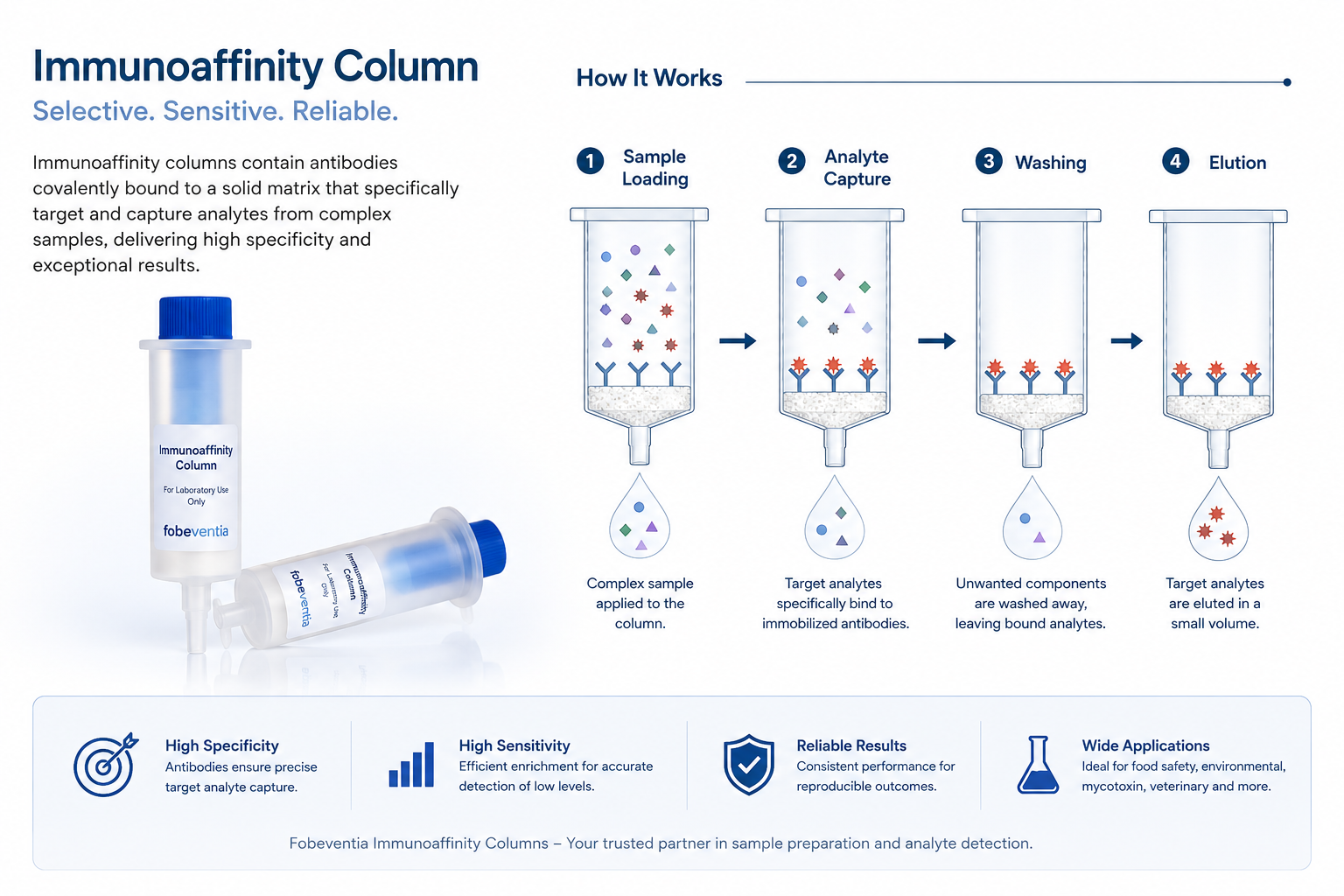
An immunoaffinity column is a highly selective sample preparation tool used to isolate specific target compounds from complex matrices before analytical testing.
These columns contain antibodies that selectively bind to target analytes, allowing unwanted substances to be washed away. The target compounds are then eluted in purified form for subsequent analysis by HPLC or other analytical techniques.
Immunoaffinity Column Principle
The immunoaffinity column principle relies on highly specific antigen-antibody interactions.
The process typically involves:
- Loading the sample onto the column.
- Target analytes bind specifically to immobilized antibodies.
- Matrix interferences are removed through washing.
- Bound analytes are released using an elution solvent.
- The purified extract is analyzed by HPLC.
Because of their exceptional selectivity, immunoaffinity columns are widely used in mycotoxin testing and food safety applications.
Immunoaffinity Column Chromatography in Aflatoxin Analysis
One of the most important applications of immunoaffinity column chromatography is aflatoxin testing.
Aflatoxins are toxic metabolites produced by Aspergillus fungi and can contaminate grains, nuts, spices, animal feed, and other agricultural products. Regulatory authorities worldwide impose strict limits on aflatoxin levels due to their potential health risks.
An immunoaffinity column for aflatoxin testing selectively captures aflatoxins from complex food matrices, eliminating interfering substances before HPLC analysis. This improves detection sensitivity and ensures reliable quantification even at very low concentration levels.
Benefits include:
- High specificity for aflatoxins
- Reduced matrix interference
- Improved analytical accuracy
- Better reproducibility
- Enhanced detection limits
HPLC Calibration Parameters
Accurate HPLC analysis requires proper instrument calibration and method validation. Important HPLC calibration parameters include:
Retention Time
The time required for a compound to travel through the column and reach the detector.
Peak Area
Used to quantify the concentration of analytes.
Linearity
Measures the relationship between analyte concentration and detector response.
Precision
Evaluates repeatability of analytical results.
Accuracy
Assesses how closely measured values match true values.
Resolution
Determines the degree of separation between adjacent peaks.
Limit of Detection (LOD)
The lowest concentration that can be detected.
Limit of Quantification (LOQ)
The lowest concentration that can be quantified reliably.
Monitoring these parameters ensures consistent and reliable HPLC performance.
Applications of HPLC in Food Safety Testing
HPLC is extensively used for:
- Mycotoxin analysis
- Aflatoxin detection
- Food additive testing
- Pesticide residue analysis
- Nutritional profiling
- Pharmaceutical quality control
- Environmental contaminant monitoring
When combined with immunoaffinity column cleanup, HPLC becomes an exceptionally powerful solution for trace-level contaminant analysis.
Why Choose Fobeventia for Immunoaffinity Columns?
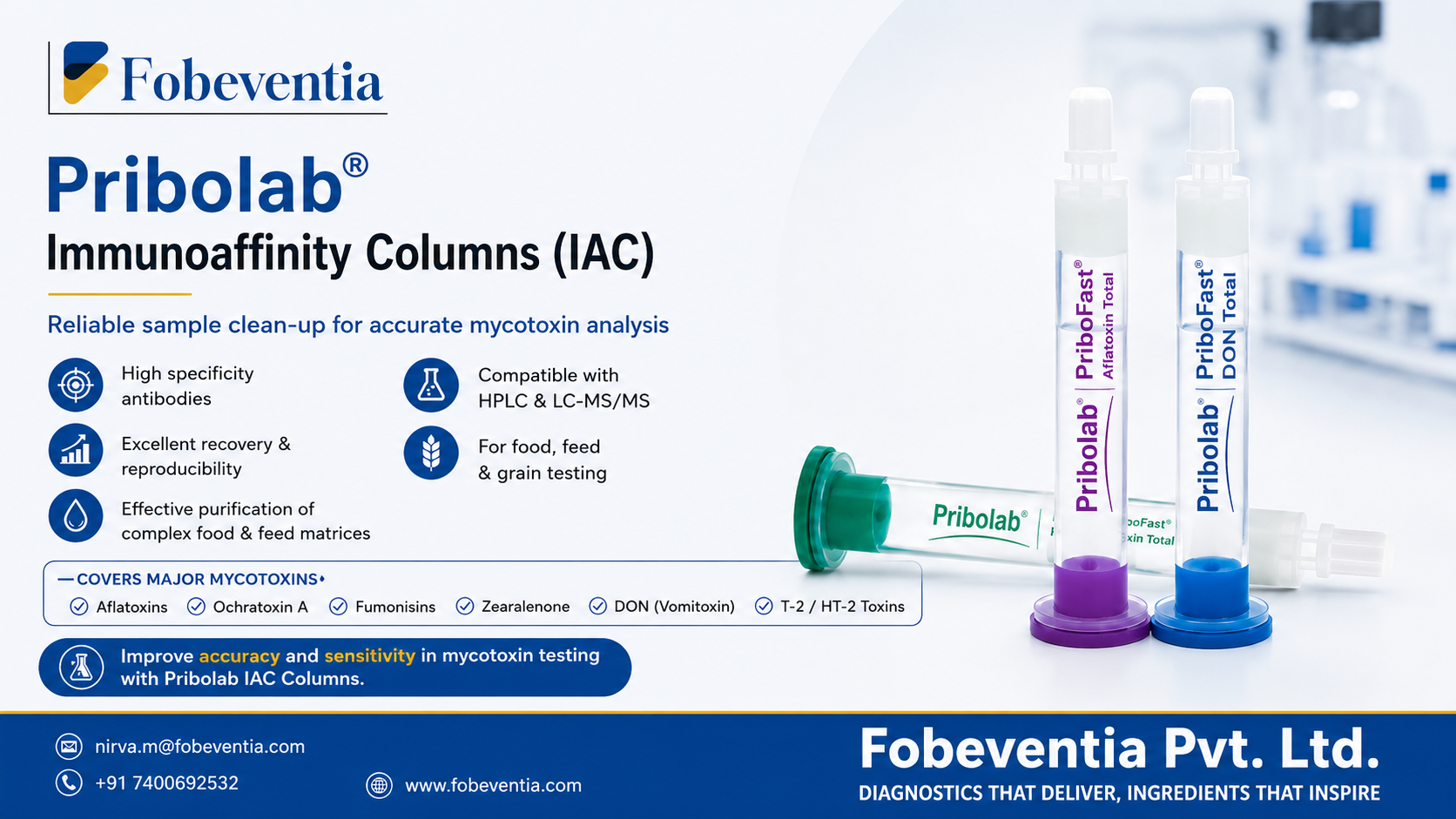
Fobeventia is committed to providing high-quality testing solutions that support accurate, reliable, and efficient food safety analysis. Our immunoaffinity columns are designed to deliver exceptional selectivity and performance, helping laboratories achieve consistent results in mycotoxin testing and other critical analytical applications.
High Specificity and Reliable Performance
Fobeventia immunoaffinity columns utilize highly specific antibodies to selectively capture target analytes, minimizing matrix interference and improving analytical accuracy. This makes them an ideal choice for aflatoxin and other mycotoxin testing workflows.
Optimized for HPLC Analysis
Our columns are developed to integrate seamlessly with HPLC-based testing methods, ensuring cleaner sample extracts, improved chromatographic performance, and enhanced detection sensitivity.
Consistent Quality Standards
Each product undergoes stringent quality control processes to ensure batch-to-batch consistency, reproducibility, and dependable performance in laboratory environments.
Support for Food Safety Compliance
With increasing regulatory requirements for mycotoxin monitoring, Fobeventia solutions help testing laboratories, food manufacturers, exporters, and quality assurance teams meet industry standards with confidence.
Comprehensive Testing Solutions
Beyond immunoaffinity columns, Fobeventia offers a range of analytical testing solutions designed to support food safety, quality control, and regulatory compliance across multiple industries.
Whether you are conducting routine screening or advanced contaminant analysis, Fobeventia immunoaffinity columns provide the reliability, accuracy, and efficiency needed for successful HPLC testing applications.
Conclusion
The HPLC principle is based on the differential interaction of analytes with mobile and stationary phases, enabling accurate separation and quantification of compounds in complex samples. As one of the most reliable analytical techniques available, HPLC chromatography continues to play a vital role across food safety, pharmaceutical, and environmental testing laboratories.
For applications such as mycotoxin and aflatoxin detection, incorporating an immunoaffinity column significantly enhances sample purity and analytical accuracy. By utilizing the immunoaffinity column principle and advanced immunoaffinity column chromatography techniques, laboratories can achieve highly sensitive and reliable results while meeting stringent regulatory requirements.
For food safety professionals seeking dependable aflatoxin testing solutions, an immunoaffinity column for aflatoxin analysis remains an essential component of an effective HPLC workflow.
hplc chromatography, hplc principle, hplc calibration parameters, immunoaffinity column for aflatoxin, immunoaffinity column, immunoaffinity column principle, immunoaffinity column chromatography, Fobeventia