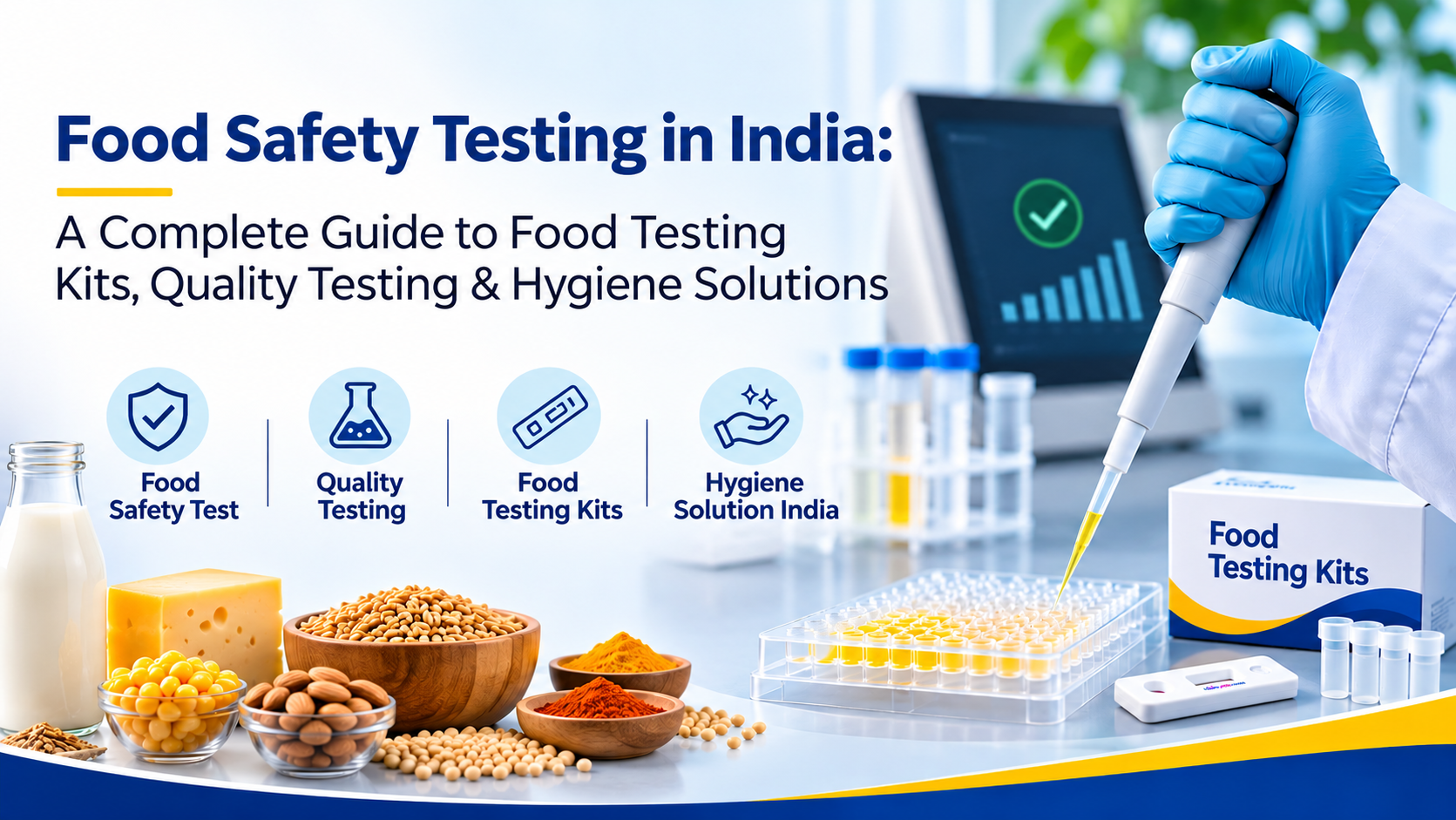
Food safety is one of the most important responsibilities for food manufacturers, processors, dairy businesses and food service operators. From checking raw materials for contaminants to monitoring production-line hygiene, every stage of the food supply chain requires effective food safety and quality testing.
A reliable food safety test helps identify potential hazards such as mycotoxins, pathogens, allergens and antibiotic residues before they compromise product safety or consumer confidence. Similarly, regular quality testing helps businesses maintain product consistency, meet applicable regulatory requirements and strengthen their quality assurance processes.
In India, where food manufacturing spans dairy, packaged foods, beverages, spices, grains, meat, poultry, seafood and nutraceuticals, selecting the right testing methods is essential.
Businesses can strengthen their food safety programmes by using appropriate food testing kits, microbiological testing methods, laboratory technologies and hygiene monitoring systems.
This guide explains the different types of food safety tests, how food testing kits work, why hygiene monitoring matters and how food businesses in India can build a more effective quality control programme.
What Is Food Safety Testing?
Food safety testing is the systematic examination of food products, ingredients, raw materials and production environments to identify biological, chemical or other potential hazards that could affect food safety and quality.
A food safety test may be used to detect:
- Mycotoxins such as aflatoxins in grains, cereals, nuts and animal feed.
- Aflatoxin M1 and antibiotic residues in milk and dairy products.
- Foodborne pathogens such as Salmonella, Listeria and E. coli.
- Undeclared allergens in processed food products.
- Genetically modified organisms (GMOs), where relevant.
- Microbial contamination on food products and production surfaces.
Food testing is not limited to identifying contamination in finished products. It also supports raw material inspection, supplier verification, in-process quality control, environmental monitoring and sanitation verification.
For food manufacturers, the objective is to identify potential risks early, make informed production decisions and establish a consistent food safety management programme.
Why Is Food Safety and Quality Testing Important for Indian Food Businesses?
India's food industry operates across complex supply chains involving agricultural producers, raw material suppliers, processing facilities, cold storage units, distributors and retailers.
Each stage can introduce different contamination and quality risks.
For example, moisture and storage conditions can contribute to mycotoxin contamination in grains and nuts. In dairy processing, aflatoxin M1 and antibiotic residues require appropriate monitoring. In packaged food manufacturing, allergens and microbiological contamination can become important quality control concerns.
A structured food safety testing programme helps businesses:
1. Identify contamination risks early
Testing raw materials and ingredients helps quality teams identify potential hazards before they enter the manufacturing process.
2. Maintain consistent product quality
Regular quality testing helps manufacturers monitor production consistency and identify deviations in product specifications.
3. Strengthen regulatory compliance
Food businesses must establish appropriate food safety management systems and follow applicable Food Safety and Standards Authority of India (FSSAI) requirements.
4. Improve production efficiency
In-house screening and rapid testing methods can help teams make quicker operational decisions, depending on the test method and application.
5. Protect consumer confidence
Consistent quality control and documented food safety practices help businesses demonstrate their commitment to safe food production.
Different Types of Food Safety Tests Used in the Food Industry
The appropriate food safety test depends on the product, potential hazard, sample matrix, required detection limits and intended application.
Here are some important testing categories used across the Indian food industry.
1. Mycotoxin and Aflatoxin Testing
Mycotoxins are toxic compounds produced by certain types of fungi. They can contaminate agricultural commodities, animal feed and processed food ingredients.
Common mycotoxins include:
- Aflatoxin B1
- Total aflatoxins (B1, B2, G1 and G2)
- Aflatoxin M1
- Ochratoxin A
- Deoxynivalenol (DON)
- Zearalenone (ZEA)
- Fumonisins
- T-2 and HT-2 toxins
Mycotoxin testing is particularly relevant for businesses handling cereals, grains, nuts, spices, animal feed and dairy products.
Common testing technologies:
- ELISA testing kits for screening and quantitative analysis.
- Lateral flow testing kits for rapid screening.
- Immunoaffinity columns (IAC) for sample clean-up before analytical methods such as HPLC and LC-MS/MS.
For example, dairy businesses may monitor Aflatoxin M1 in milk, while grain processors may require testing for aflatoxin B1 and total aflatoxins.
2. Antibiotic Residue Testing
Antibiotic residues can enter the food supply chain through the use of veterinary medicines in livestock and dairy production.
For dairy manufacturers and milk collection centres, testing milk for antibiotic residues is an important quality control activity.
Antibiotic residue testing kits can help detect relevant compounds in milk and other applicable food matrices.
Depending on the analyte and testing requirements, businesses may use rapid screening methods or ELISA-based technologies.
3. Food Allergen Testing
Food allergens are ingredients or substances that may trigger allergic reactions in sensitive consumers.
Cross-contact can occur through shared equipment, processing lines, storage areas or inadequate cleaning procedures.
Food allergen testing helps manufacturers verify allergen control procedures and evaluate the presence of specific allergens in food products.
Commonly monitored allergens include:
- Milk
- Egg
- Peanut
- Soy
- Gluten-containing cereals
- Tree nuts
ELISA and lateral flow technologies are commonly used for allergen detection, depending on the allergen, sample matrix and testing objective.
4. Food Pathogen Detection
Pathogenic microorganisms can cause foodborne illnesses and create significant risks for manufacturers.
Some important foodborne pathogens include:
- Salmonella
- Listeria monocytogenes
- Escherichia coli (E. coli)
- Campylobacter
- Cronobacter
Food pathogen detection is particularly relevant for dairy, meat, poultry, seafood, ready-to-eat foods and processed food manufacturers.
Modern PCR-based pathogen detection systems can identify target microorganisms through DNA amplification. These technologies can support faster detection workflows and improve laboratory efficiency.
The selected method must be appropriate for the target organism, sample matrix and required detection performance.
5. Microbiological Testing
Microbiological testing helps evaluate microbial populations in food products, ingredients and production environments.
It can include the enumeration of aerobic bacteria, coliforms, yeasts and moulds, as well as detection of specified microorganisms.
Ready-to-use microbiological media plates can simplify routine laboratory workflows by reducing preparation requirements and making microbial enumeration more convenient.
These solutions are useful for food manufacturers, dairy processors, quality control laboratories and food testing facilities.
What Are Food Testing Kits and How Do They Work?
Food testing kits are specialised tools designed to detect specific contaminants, residues, allergens or quality parameters in food and food-related samples.
Depending on the technology, these kits can support rapid screening, routine quality control or quantitative laboratory analysis.
Modern food testing kits are designed to help quality teams obtain relevant analytical information without relying on the same testing workflow for every sample.
Choosing food testing kits should involve more than comparing prices or testing speed.
Businesses should evaluate the target analyte, food matrix, sensitivity, detection limit, testing capacity, method validation, equipment requirements and technical support.
It is also important to distinguish rapid screening from confirmatory analysis. A rapid screening result does not automatically replace laboratory analysis where regulatory, contractual or risk-management requirements call for a specific validated method.
Why Hygiene Monitoring Is Essential in Food Manufacturing
Testing finished food products is only one part of an effective food safety programme.
Manufacturers must also monitor the cleanliness of processing equipment, food contact surfaces, utensils, conveyors, storage areas and water systems.
This is where hygiene monitoring solutions become important.
Traditional microbiological testing can require sample preparation and incubation. ATP-based hygiene monitoring provides a faster method to verify cleaning effectiveness and identify residual biological contamination.
What Is ATP Hygiene Monitoring?
ATP stands for Adenosine Triphosphate, a molecule found in living cells and biological materials.
ATP hygiene monitoring uses a bioluminescence reaction to measure ATP-related light output from a collected sample.
A typical ATP hygiene monitoring process involves:
- Surface sampling: A specialised ATP swab is used to collect residues from a defined surface.
- Reagent activation: The swab is activated to initiate the bioluminescence reaction.
- Measurement: The sample is inserted into an ATP luminometer.
- Result interpretation: The instrument measures light output in Relative Light Units (RLU).
- Corrective action: The quality team compares results against facility-specific limits and repeats cleaning or investigation when required.
The process provides rapid feedback, often within seconds, allowing production teams to verify sanitation before operations resume.
An important distinction: ATP testing is a sanitation verification tool, not a pathogen identification test. It does not tell you whether a particular bacterium, such as Salmonella or Listeria, is present. Microbiological testing is still necessary for organism-specific detection.
ATP monitoring can be used to evaluate cleaning effectiveness on:
- Food contact surfaces
- Processing equipment
- Conveyor belts
- Storage tanks
- Utensils and worktables
- Cleaning-in-place (CIP) systems
- Water and rinse samples using suitable ATP test methods
Choosing the Right Hygiene Solutions in India
For food manufacturers looking for effective hygiene solutions in India, the selection process should begin with the facility's actual sanitation risks.
A dairy processing facility, for instance, may require hygiene monitoring for processing equipment and CIP systems. A packaged food manufacturer may prioritise food contact surfaces, conveyors and packaging equipment.
A suitable hygiene monitoring programme should consider:
Facility requirements: Identify the equipment, production areas and surfaces that require routine monitoring.
Testing method: Select surface ATP swabs, water ATP testing or other suitable hygiene verification methods.
Instrument performance: Evaluate luminometer sensitivity, usability, data recording and operational requirements.
Testing frequency: Establish a frequency based on risk assessment, production schedules, sanitation procedures and facility validation.
Corrective action: Define what happens when a result exceeds the facility's acceptable threshold.
An ATP monitoring system is most useful when it forms part of a documented sanitation verification programme rather than functioning as an isolated testing activity.
FSSAI Requirements and Food Safety Management in India
Food safety compliance in India is governed by the Food Safety and Standards Act, 2006, and the regulations and directions issued by FSSAI.
Food Business Operators (FBOs) must establish appropriate food safety management systems and follow applicable hygiene and sanitary practices.
Schedule 4 of the Food Safety and Standards (Licensing and Registration of Food Businesses) Regulations, 2011, addresses Good Manufacturing Practices (GMP), Good Hygiene Practices (GHP) and other sanitary requirements for food businesses.
An effective Food Safety Management System (FSMS) should include:
- Identification and assessment of food safety hazards.
- Appropriate raw material inspection and testing.
- In-process and finished-product quality control.
- Cleaning and sanitation procedures.
- Pest control and environmental hygiene.
- Monitoring and corrective action procedures.
- Proper testing records and documentation.
- Periodic review of food safety controls.
FSSAI's official food testing guidance also describes testing of food products through FSSAI-notified or NABL-accredited laboratories. Its published guidance specifies testing at least once every six months for applicable food product categories. Businesses should verify their current product-category requirements, licensing conditions and relevant regulatory directions before establishing their testing schedule.
The RAFT scheme is particularly relevant to rapid testing. FSSAI evaluates and approves specified rapid testing kits, equipment and methods under this scheme for appropriate screening and surveillance applications. Not every rapid testing kit on the market should be assumed to have RAFT approval.
How to Build an Effective Food Safety Testing Programme
Selecting the right testing technology is only the beginning. Food businesses should integrate testing into their daily quality assurance operations.
Here is a practical framework:
Step 1: Identify potential hazards
Map the raw materials, ingredients, production processes and finished products that require monitoring.
Step 2: Define testing requirements
Identify which analytes need to be tested, the relevant sample matrices and the required detection or quantification limits.
Step 3: Select suitable testing methods
Choose between rapid testing, ELISA, PCR, ready-to-use microbiological media, ATP monitoring and confirmatory analytical methods according to the application.
Step 4: Establish a testing schedule
Develop a risk-based schedule covering incoming raw materials, in-process samples, finished goods and production hygiene.
Step 5: Document results
Maintain records of sample identification, testing methods, results, acceptance criteria and corrective actions.
Step 6: Review and improve
Evaluate recurring failures, supplier performance, sanitation trends and testing results to continuously improve the food safety management system.
This systematic approach helps businesses move from reactive testing to preventive quality management.
Why Choose Fobeventia for Food Safety and Quality Testing Solutions in India?
Finding the right testing technology can be challenging, particularly when different products, sample matrices and production processes require different analytical methods.
Fobeventia provides food safety testing, laboratory technologies, hygiene monitoring systems and food ingredient solutions for the Indian food and beverage industry.
Its portfolio supports different stages of food safety and quality control, from raw material screening to production hygiene verification and laboratory analysis.
Food Safety Testing Kits
Fobeventia offers testing solutions for:
- Mycotoxins and aflatoxins.
- Aflatoxin M1 in milk and dairy products.
- Food allergens.
- Antibiotic residues.
- GMO testing.
- Food pathogen detection.
- Microbiological testing.
Explore Fobeventia's Food Safety Testing Solutions.
Hygiene Monitoring Systems
Fobeventia provides ATP-based hygiene monitoring solutions designed to help food businesses verify surface and water cleanliness.
The range includes ATP luminometers, surface ATP tests and water ATP testing solutions.
Explore Fobeventia's Hygiene Monitoring Solutions.
Advanced Laboratory Technologies
Fobeventia's broader portfolio includes ELISA readers, ready-to-use microbiological media plates, immunoaffinity columns and other laboratory technologies.
These solutions support testing laboratories and quality control teams working with different food matrices and analytical requirements.
Technical Consultation and Pan-India Support
Choosing an appropriate testing method requires an understanding of the target analyte, sample matrix, testing objective and operational requirements.
Fobeventia provides technical consultation, product recommendations, method selection, demonstrations and after-sales support for food businesses across India.
Based in Indore, Madhya Pradesh, Fobeventia combines international testing technologies with local technical support to serve food manufacturers, laboratories and quality teams across the country.
Strengthen Your Food Safety and Quality Testing Programme with Fobeventia
Food safety requires more than inspecting finished products. It involves a coordinated approach to raw material testing, contamination detection, microbiological analysis, production hygiene and quality control.
Whether you operate a dairy processing unit, food manufacturing facility, beverage plant, nutraceutical business or testing laboratory, choosing suitable food testing kits and hygiene monitoring technologies can help strengthen your quality assurance processes.
Fobeventia brings food safety testing technologies, laboratory solutions and technical expertise together to help Indian food businesses make better testing decisions.
Looking for the right food safety test, food testing kits or hygiene monitoring solution?
Explore Fobeventia's solutions or speak with its technical team to identify a suitable testing approach for your business.